Autumn special offer CHECK - UPS With Our Associate dentist, Down from £98 to £55. Small X-rays are included if needed.
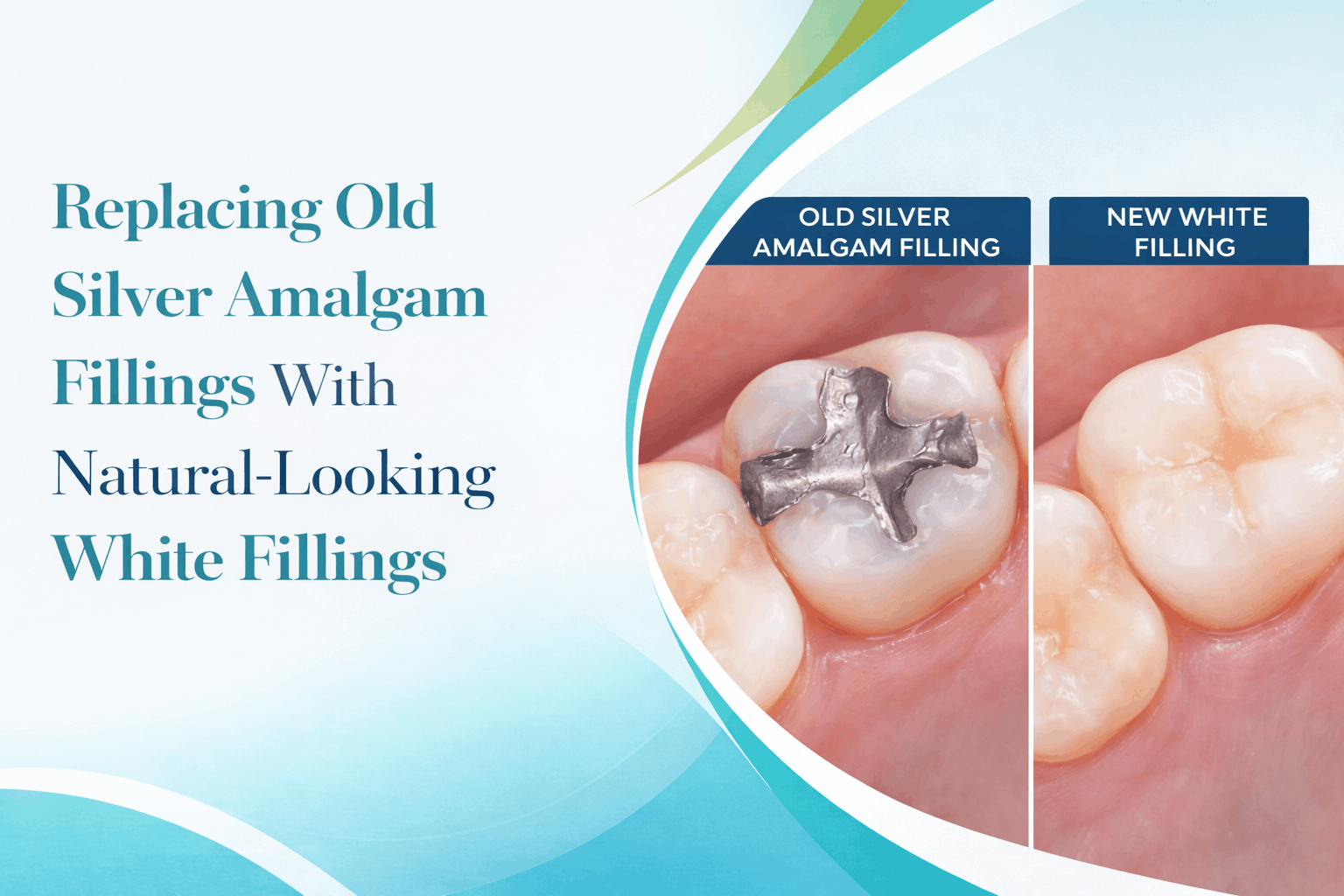
Many people still have old silver amalgam fillings that were placed years ago when this was the standard material used to repair cavities. Today, more and more patients in Holborn, Tottenham Court Road, Bloomsbury, Charlotte Street and Chancery Lane are asking to replace these dark metal fillings with modern white options that are stronger, more aesthetic and metal-free. Advances in dental materials now allow us to restore teeth in a way that blends seamlessly with natural enamel while preserving more healthy tooth structure.
Amalgam fillings, often referred to as 'silver fillings', are made from a mixture of metals including silver, tin, copper and mercury. They have been used in dentistry for over 150 years because they are durable, cost-effective and relatively easy to place. For decades they were considered the standard solution for treating cavities, especially in back teeth.
However, amalgam fillings are dark grey in colour and can become even darker over time. This makes them very noticeable when you smile, laugh or open your mouth widely. Large amalgam fillings can also expand and contract slightly with temperature changes, which in some cases may contribute to cracks in the surrounding tooth structure.
Composite resin is a tooth-coloured material that bonds directly to your tooth. It is ideal for small to medium cavities and for replacing small to moderate amalgam fillings. The material is placed in layers, shaped carefully and then hardened using a special curing light.
For larger cavities or heavily restored teeth, ceramic inlays and onlays may be recommended. These restorations are custom-made in a dental laboratory or designed digitally for precision fit and long-term durability.
Not every amalgam filling needs to be replaced. If a silver filling is intact, functioning well and the surrounding tooth is healthy, there may be no urgent clinical need to change it. The decision depends on aesthetics, structural integrity, decay risk and patient preference.
A thorough examination, including digital X-rays where appropriate, allows us to assess whether a filling is leaking, cracked, worn or contributing to structural weakness.
White fillings and ceramic restorations can last many years when properly maintained. Good oral hygiene and regular professional care are essential.
If you are considering replacing old silver fillings with natural-looking white alternatives, we invite you to arrange a consultation.

With Associate dentist only.
Dr Fabrizio Castellari, Dr Moshin Nathu, Dr Nayanthara Perera, Dr. Oliver Tomlinson. CHECK- UPS Down from £98 to £55Small X-rays are included if needed.
FREE Whitening consultation included.