Autumn special offer CHECK - UPS With Our Associate dentist, Down from £98 to £55. Small X-rays are included if needed.
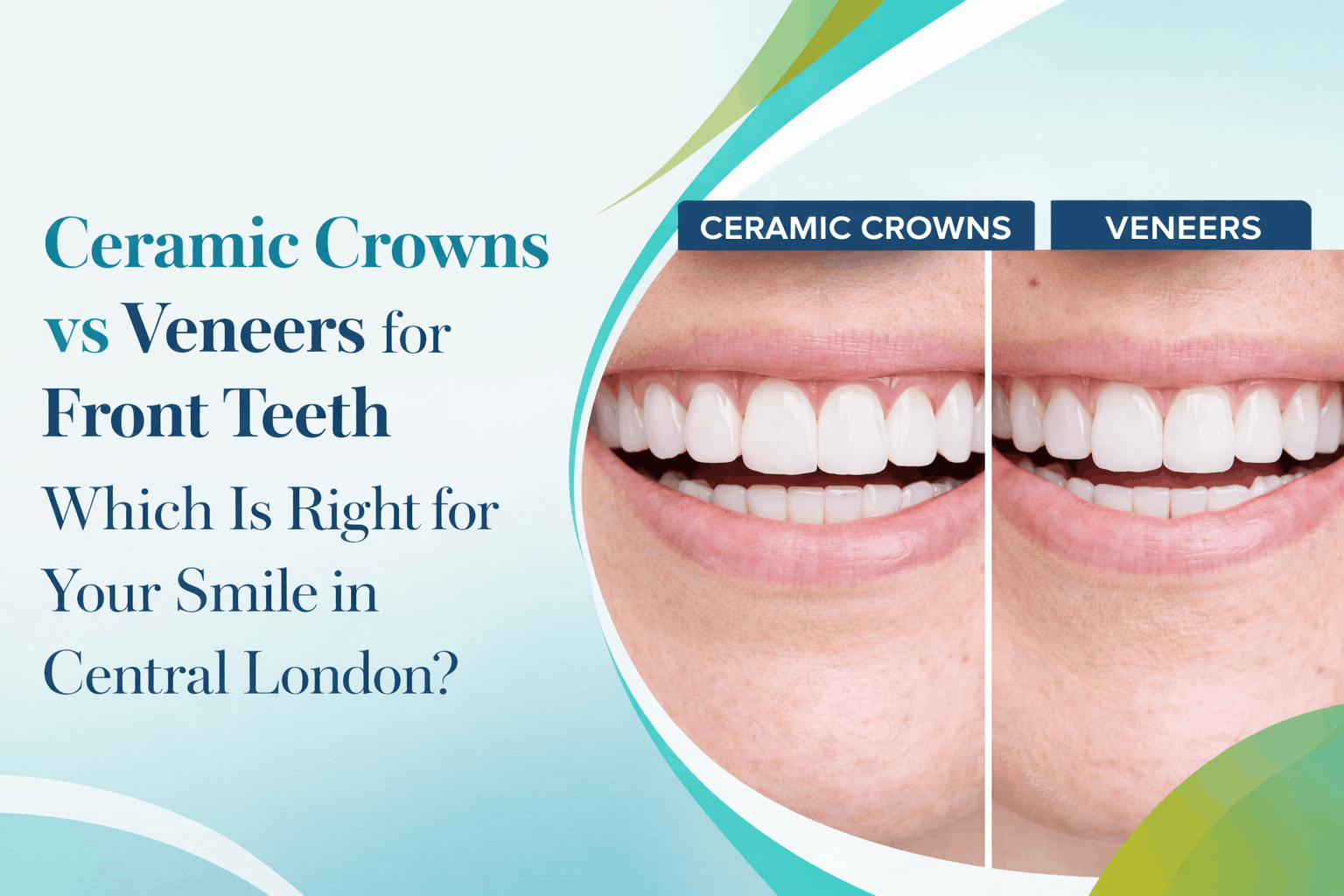
Many patients who visit Museum Dental Suites, our private dental practice in Holborn, central London, want to improve the colour, shape or alignment of their front teeth but are unsure whether they need veneers or crowns. Both treatments use highly aesthetic ceramic materials and can completely transform a smile, yet they differ in how much tooth structure they cover and how much tooth needs to be reshaped.
Understanding the difference between ceramic crowns and veneers – and the materials used, such as feldspathic porcelain and Emax – will help you make an informed decision with your cosmetic dentist in Holborn, close to Tottenham Court Road, Bloomsbury, Charlotte Street and Chancery Lane.
A veneer is a thin, custom‑made ceramic layer that is bonded to the front surface of a tooth. It is designed to enhance the visible part of the tooth when you smile, without covering the whole tooth.
Key points about veneers:
* They mainly cover the front and just wrap slightly around the edges.
* They are very thin – typically only around 0.2 to 0.7 mm at the front.
* At the back (unseen surface), preparation is minimal, often up to around 1 mm at most.
* They are ideal when most of the tooth is healthy and you mainly want to change colour, shape or minor alignment.
Because veneers are so thin, they rely on strong bonding to the enamel and very precise preparation. A skilled cosmetic dentist at Museum Dental Suites will work carefully within these small measurements to preserve as much natural enamel as possible while still allowing space for natural‑looking ceramic.
A crown is sometimes described as a “cap” that covers more of the tooth all the way around. A ceramic crown on a front tooth looks very similar to a veneer from the front, but it extends further over the back and sides of the tooth.
Key points about crowns:
* They cover the entire visible part of the tooth above the gum line.
* They usually require more reduction of the tooth than veneers, especially on the back surface.
* They are often used when a tooth is heavily filled, cracked, root‑treated or significantly weakened.
* They improve strength and function as well as appearance.
On the front surface, a crown and a veneer can look identical in the final smile. The main difference is how far down the back, unseen surface the restoration extends and how much reinforcement it gives to the underlying tooth.
Ceramic veneers and crowns can be made from different types of porcelain, each with its own strengths and characteristics. At Museum Dental Suites in Holborn, we commonly use feldspathic porcelain and Emax for front teeth.
Feldspathic porcelain is traditionally known for its exceptional aesthetics. It is built up in layers by a skilled technician, allowing them to mimic:
* Natural translucency.
* White “halo” effects.
* Subtle characterisation seen in real enamel.
However:
* It is relatively brittle compared with newer materials.
* It performs best in patients with a normal or lighter bite.
* In patients with a strong bite, clenching, grinding or a deep overbite, it may chip or fracture more easily if not carefully planned.
Emax is a modern glass ceramic that has become the generally preferred material for many front tooth crowns and veneers at our Holborn cosmetic dental clinic.
Advantages of Emax:
* High strength compared with traditional feldspathic porcelain.
* Very good aesthetics – it can still look extremely natural.
* Suitable for many patients with a stronger bite when designed correctly.
* Can be used for both crowns and veneers in the front region.
Although veneers and crowns can look the same from the front, the choice depends on the overall condition of the tooth and your bite. During your consultation, your dentist will consider:
* Depth and strength of your bite: In a deep or powerful bite, the edges of the front teeth take more force. Sometimes a crown is safer than a thin veneer.
* Existing fillings: If a tooth has large fillings, it may not have enough strong enamel left to support a veneer.
* Presence of root canal treatment or dark teeth: Root‑treated front teeth can become darker and more brittle; crowns often hide discolouration more effectively.
* Amount of enamel present: Veneers rely on bonding to enamel. If much of the enamel has been lost, a crown may provide better stability.
A typical process for veneers or crowns on front teeth at our Holborn practice includes:
* Consultation and assessment: Discussing goals, bite, and dental health.
* Smile design and planning: Using photographs and digital scans for a "preview."
* Tooth preparation: Reshaping teeth within minimal measurement ranges.
* Temporary restorations: Protecting the teeth while the final ceramic is made.
* Final fitting and bonding: Checking fit and colour before permanent bonding.
* Aftercare and maintenance: Regular reviews and hygiene visits.
Neither is automatically “better”; it depends on the health and strength of your teeth. Veneers are more conservative, while crowns offer more reinforcement.
Some temporary sensitivity is possible, but this usually settles once the final restorations are bonded.
With good hygiene, many can last well over 10 years.
With Associate dentist only.
Dr Fabrizio Castellari, Dr Moshin Nathu, Dr Nayanthara Perera, Dr. Oliver Tomlinson. CHECK- UPS Down from £98 to £55Small X-rays are included if needed.
FREE Whitening consultation included.